


Study
Modern Science Journal (2026). DOI: 10.22551/MSJ.2026.02.20 https://doi.org/10.3390/jfb17070328
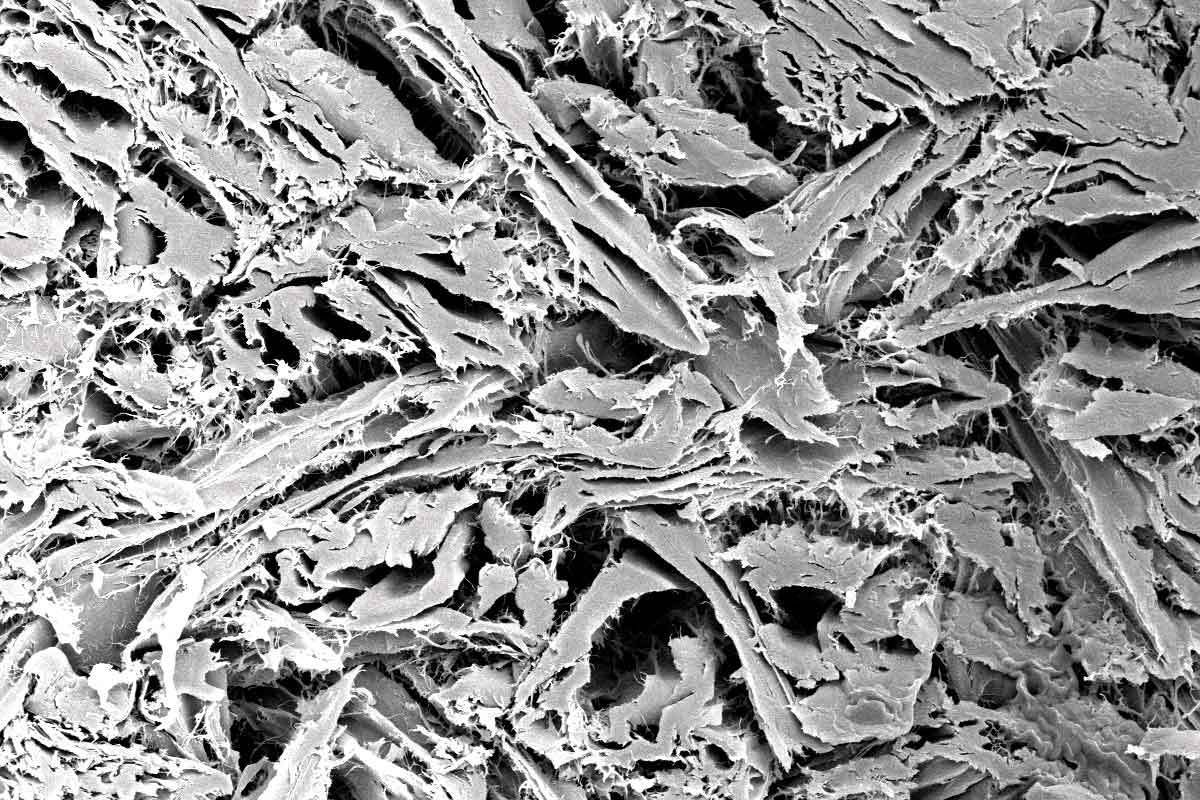
In this exploratory study atomic force microscopy (AFM) was used to characterize the nanoscale surface topography of the three-dimensional porcine collagen matrix (mucoderm®) under hydrated conditions, simulating the physiologically relevant environment of clinical periodontal and soft tissue applications.
STUDY DESIGN
mucoderm® was hydrated in sterile 0.9% NaCl solution. AFM analysis (EasyScan 2 system, Dynamic Force/Non-Contact mode) was performed on 5 × 5 µm scan areas in wet conditions. Evaluated parameters included height (topography), deflection signal, 3D reconstruction, surface profiles, quantitative roughness (Sa, Sq, Sz, Ssk, Sku), and height distribution histograms. Samples were mounted on poly-L-lysine-coated slides for stability.
KEY FINDINGS
- The hydrated mucoderm® matrix exhibited a continuous, moderately undulating surface with homogeneous distribution of rounded elevations and depressions, consistent with an isotropic collagen network and no detectable structural defects or abrupt discontinuities.
- Deflection imaging highlighted local slope variations and microstructural heterogeneities.
- 3D reconstructions confirmed uniform spatial organization with gradual height transitions.
- Quantitative roughness parameters showed moderate values: Sa = 0.1179 µm, Sq = 0.1765 µm, Sz = 1.541 µm. Height distribution was centered around the mean plane with controlled dispersion.
CONCLUSION
Under hydrated conditions, mucoderm® presents a stable, continuous, and moderately rough nanoscale surface morphology that supports favorable biological interactions, including protein adsorption, cell adhesion, and tissue integration. These features reflect stable structural behavior and suggest surface properties highly compatible with hydrated environments, providing favorable implications for soft tissue adaptation and clinical performance.
This AFM characterization provides valuable nanoscale insights into mucoderm®’s surface behavior in physiologically relevant conditions.